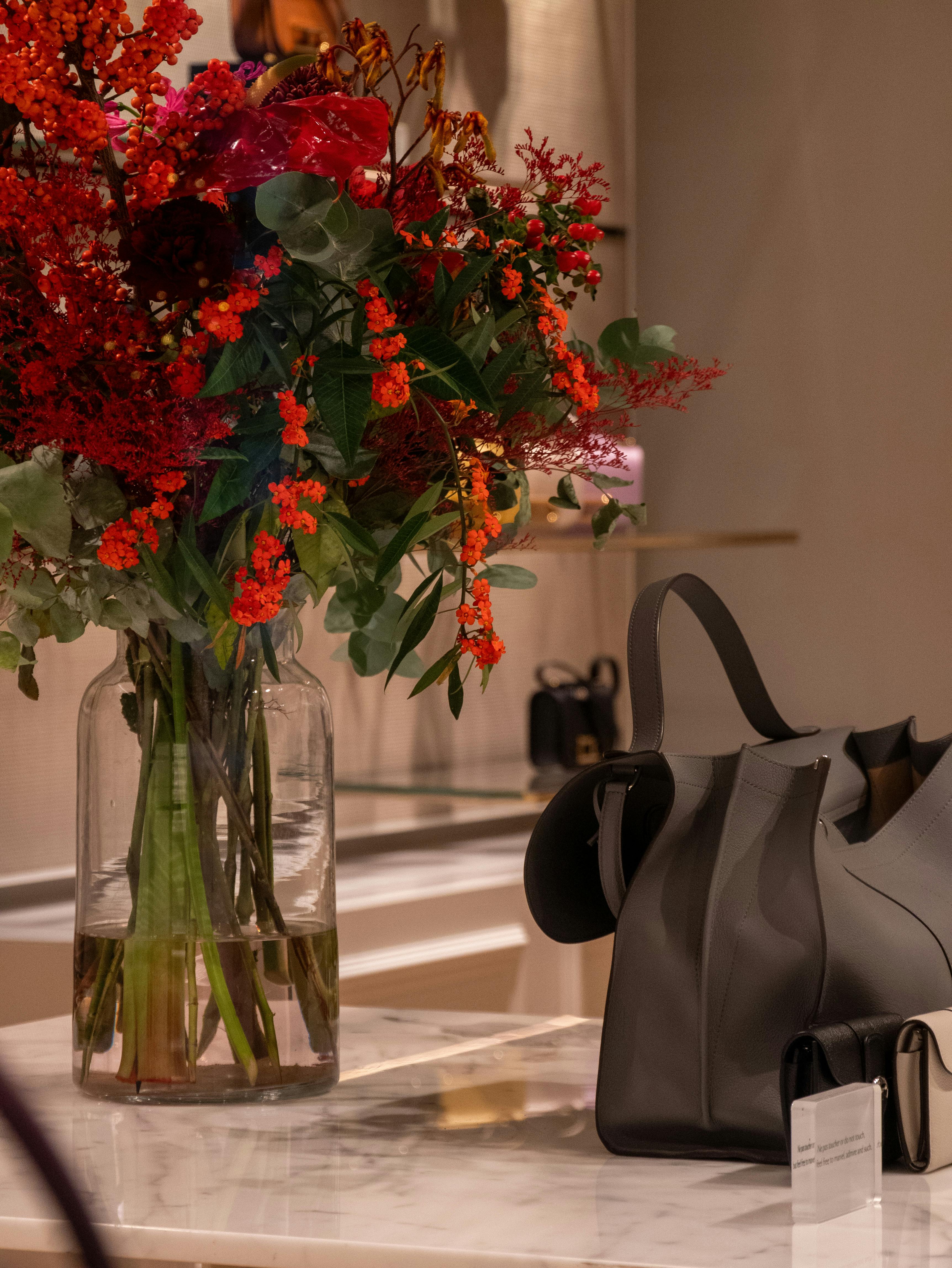
The Loewe Puzzle: Cubist Origami and Geometric Spatial Re-Engineering
Introduced in 2015 as the debut accessory designed by Jonathan Anderson for the historic Spanish house Loewe, the Puzzle bag represents an extraordinary synthesis of cubist art principles, advanced pattern geometry, and mathematical structural engineering. The defining characteristic of the Puzzle is its highly innovative, non-Euclidean body construction, which allows a spacious, three-dimensional rectangular prism to collapse entirely flat into a two-dimensional geometric plane without causing structural creasing or irreversible leather deformation. The architectural blueprint achieves this through a meticulous arrangement of forty distinct, asymmetrical panels of premium box calfskin, each precisely cut with laser tolerances and assembled in a highly specific structural sequence. Each individual leather piece is skived down at the edges to minimize bulk, then hand-painted with tonal matte edge-sealants (tintura) before being meticulously joined by narrow, parallel rows of topstitching that act as mechanical hinges. This complex jigsaw framework allows the bag to articulate along its seam lines, flexing dynamically in response to gravitational loads and the internal pressure of its cargo. The bag's multi-functional suspension system, featuring a pivoting top handle and a detachable shoulder strap anchored by solid brass carabiners, enables five distinct carrying configurations, transforming the vessel from a traditional shoulder satchel to a casual clutch or a contemporary backpack. From an industrial design perspective, the Puzzle is highly celebrated for its revolutionary volumetric adaptability and its celebration of architectural abstraction over traditional hardware-heavy decoration. However, a material and maintenance analysis highlights that the presence of forty separate interlocking leather panels dramatically increases the cumulative length of exposed hand-painted edges, making the structure more susceptible to environmental moisture absorption and edge-cracking over decades of continuous exposure, presenting an intellectual tension between complex kinetic geometry and long-term material longevity.